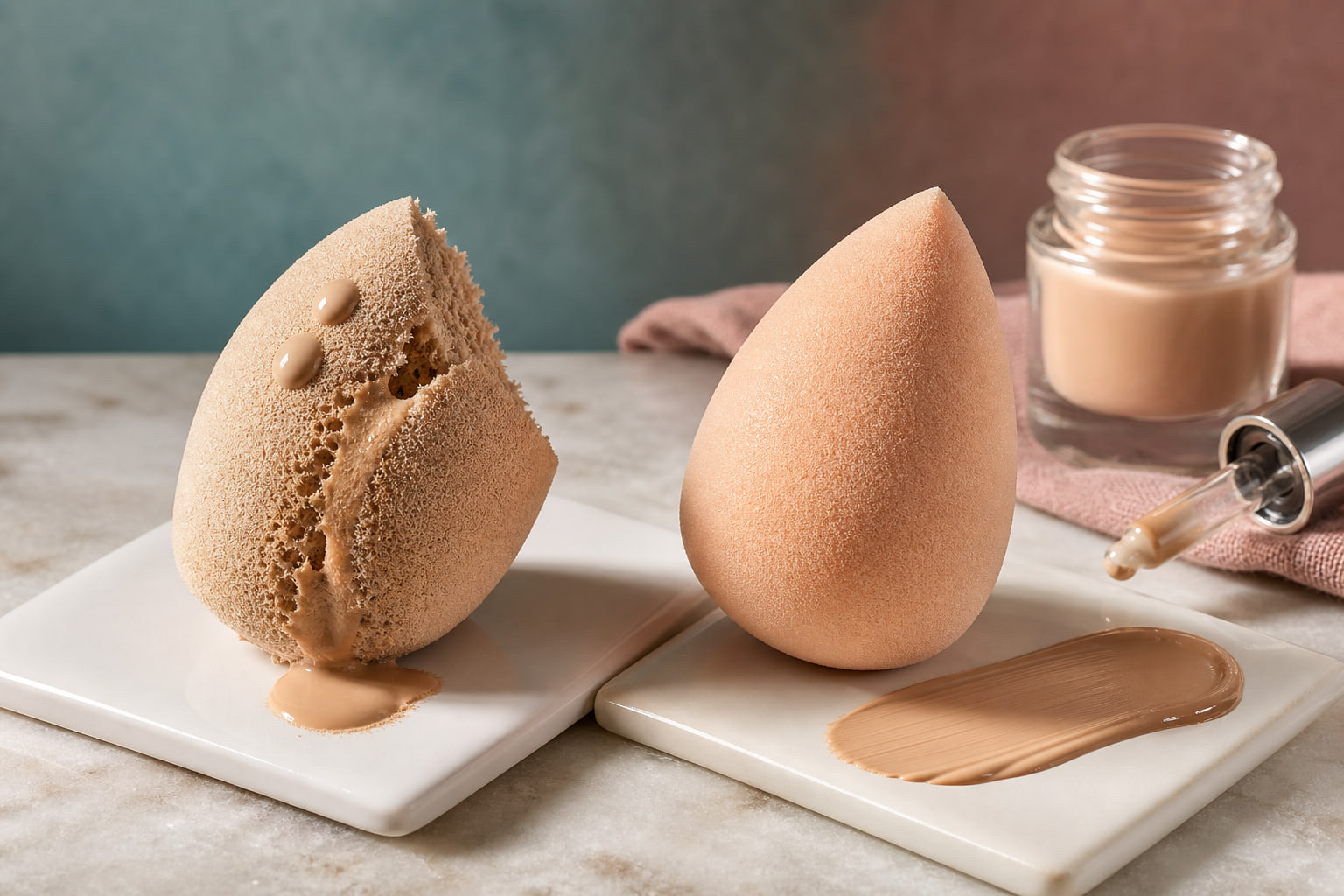
Your sponge should blend foundation, not become the main event. When coverage looks thin or patchy, it’s worth checking how you prep the tool, how much you load and how you move it. Those are useful things to adjust, but they don’t establish how much foundation a sponge absorbs or guarantee that you’ll use less.
A sponge, a formula and an application method work together. Foundation left on the tool is not a measurement of waste, and a patchy finish alone cannot tell you where the product went. We have not measured foundation savings for this article.
Prep: check the wet-and-squeeze instructions
Start with the directions for your particular sponge. For example, Beautyblender’s Original instructions say to wet it for each use, squeeze out excess water, using a towel if needed, and bounce to blend. Real Techniques’ Miracle Complexion Sponge directions also specify wetting before use and applying damp. These are instructions for those tools, not a rule for every applicator.
If your sponge is intended for damp use, squeeze out excess water before applying makeup. Follow its directions rather than assuming that wetter is better, or that damp use proves a saving.
How to load and apply
Start with a small amount and add more where you want coverage. Two approaches to try:
Dot method: place small dots of foundation where you need it and bounce to blend.
Hand-pick method: put a small amount on the back of a clean hand, pick it up with the sponge, then bounce onto the face.
Work in thin layers, building coverage gradually. This lets you assess the finish before adding more; it is not a measured comparison of product use.
The Beautyblender directions recommend a bouncing motion. Try a gentle “press and lift” rather than repeatedly rubbing an area you have already covered. Choose the part of the sponge that fits the area you are working on; the right shape depends on the tool.
Cleaning, storage and replacement
Check the manufacturer’s replacement guidance. If the sponge is damaged or no longer works as intended, replace it. A worn surface is a reason to inspect the tool, not evidence that it absorbs a particular amount of foundation.
Care instructions differ. Beautyblender says to cleanse its Original after each use and let it dry completely in a clean, ventilated place; it warns against enclosed storage while wet. Real Techniques advises rinsing its Miracle Complexion Sponge after each use, deep cleaning weekly and air drying thoroughly. Follow the current care and replacement instructions for your own sponge.
If you prefer a brush or another applicator, compare how it applies your usual foundation. Choose the finish and handling you like rather than assuming that a different tool will save a measurable amount.
Troubleshooting checklist
Patchy finish: try less product at a time and check the tool’s prep instructions.
Coverage changes during the day: don’t assume the sponge is the cause; look at the whole routine and change one thing at a time.
Damaged or difficult-to-clean sponge: check its care and replacement guidance.
You can compare application methods to find one you prefer. A casual side-by-side look at the finish does not establish how much foundation was absorbed or saved. The useful takeaway is modest: prep as directed, start with a small amount and assess before adding more.
Sources and scope
This is technique guidance, not a comparative product test. The linked manufacturer pages support the named tools’ use and care directions; they do not establish universal foundation savings. Results depend on the sponge, formula and application.