The container has rather upstaged whatever went inside it.
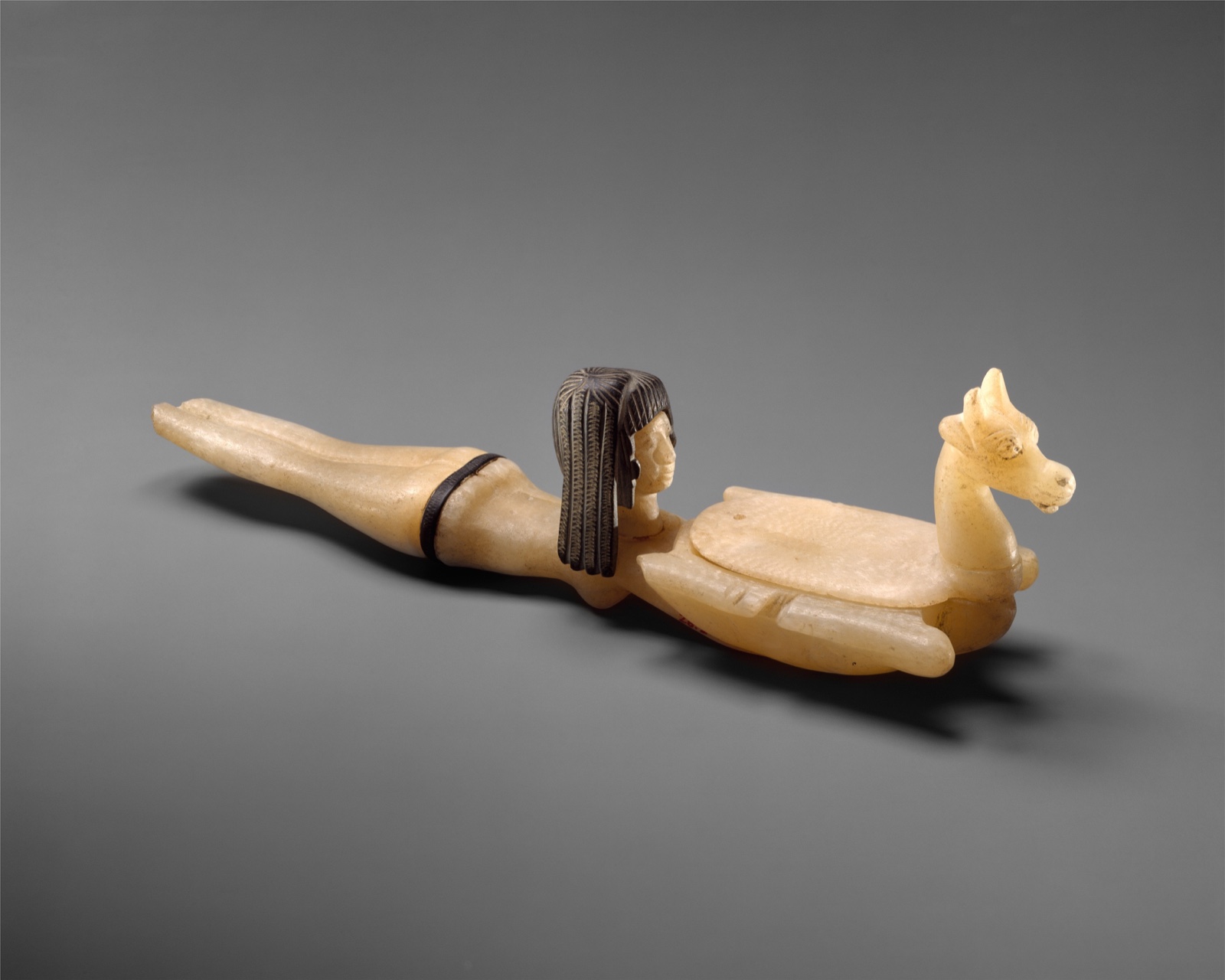
In The Metropolitan Museum of Art’s collection, a swimming woman stretches out behind an antelope-shaped dish. Pale stone meets dark, carefully worked hair. The composition has movement, even in a photograph: the body extended, the arms reaching forward, the animal’s head rising at the other end. It is an extravagant answer to a small storage problem.
The museum dates this Egyptian cosmetic spoon to around 1386–1347 BCE, during the reign of Amenhotep III. Made from travertine, also called Egyptian alabaster, and steatite, it measures 22.5 centimetres long. A peg originally allowed the container’s lid to swing aside. The Met identifies its contents only as some sort of cosmetic. There is no reason to improve that description with an imaginary ancient skincare routine.
There is already plenty to look at.
Beauty packaging is often discussed as though appreciating it were a minor lapse in judgement. We know we are supposed to care about the formula. We know the bottle cannot moisturise us. Yet a beautiful container asks for a different sort of attention, and sometimes it deserves it. The shape, the proportions and the way it opens are part of the object we have chosen to live with.
That is where the Egyptian spoon makes an interesting interruption. It gives a useful thing an imaginative form. It does not tell us whether its original owner enjoyed showing it off, carried it anywhere or thought of it as luxurious. Those are tempting stories, particularly for a beauty writer. The surviving object cannot supply them.
A case that could leave the house
For a clearer account of beauty becoming an accessory, move forward to a very different object. Cincinnati Art Museum holds an American vanity case dated 1925–30: a small, hexagonal design in pale green and black, decorated with rhinestones and finished with a cord and tassel. Inside are a mirror, a powder compartment and a puff. The museum explicitly describes it as designed to be carried as a purse.
Here, portability is documented rather than imagined. The case gives the things needed for a touch-up their own arrangement, then gives that arrangement a public face. It can hang from the hand. Its decoration remains visible when the powder is shut away.
The museum places it within a 1920s beauty culture shaped by films, magazines and an expanding cosmetics industry. Its label connects makeup both to women’s self-expression and to growing expectations about their appearance. That tension feels more interesting than a simple story of glamorous progress. Being equipped to appear in public can be a pleasure. It can also become another standard to maintain.
The two objects do not establish a neat family tree from ancient Egypt to the modern compact. They belong to different societies, with different uses and meanings. Put beside one another, though, they make it easier to ask what a beauty container is being asked to do. Hold something safely? Make it available away from home? Give it ceremony? Be admired in its own right?
These are still useful questions at a beauty counter. A pleasing closure has a job beyond its sound. A case that earns its place in a handbag needs to open when wanted and stay closed when not. Decoration can make an everyday action feel considered. None of those pleasures proves that the formula is good, or that the price is sensible.
Nor does admiration require ownership. Looking carefully at an extraordinary old container is a perfectly satisfying beauty experience without a checkout at the end.
The Egyptian swimmer does not need to be recruited as the first influencer, or made responsible for our weakness for a handsome compact. She offers something better: a reason to linger over the making. Beauty’s outside can deserve a serious look. The contents still have to answer for themselves.