A rising sales line is an excellent business story. At a beauty counter, it can quietly become a different kind of reassurance: surely all those purchases mean the products work. The useful question is what has actually been measured. A company’s commercial success and your experience of a cream deserve separate evidence.
The Estée Lauder Companies reported net sales of $3.715 billion, up 7%, for the quarter ended 30 September 2026. Its 2 November release calls this the first quarter of fiscal 2027. Organic growth was 6%.
Organic, here, concerns the accounts, not the ingredients. The company’s definition removes currency translation and specified restructuring and portfolio effects. It helps compare sales on a more consistent basis. It does not turn a sales total into a measure of better skin.
This is also a group story. The official brand directory includes Clinique, M·A·C and La Mer alongside Estée Lauder. A familiar name on your bathroom shelf can be part of a much larger business. A group total cannot tell you whether every brand, shade or formula has found its audience, still less whether it deserves yours.
The percentage is only part of the story
The SEC’s guide to financial statements makes a useful distinction: gross profit comes after cost of sales, while operating expenses still have to be deducted. Marketing, research and administration have to be paid for too. Gross margin expresses that earlier subtotal as a share of sales. It is not the money left after every bill.
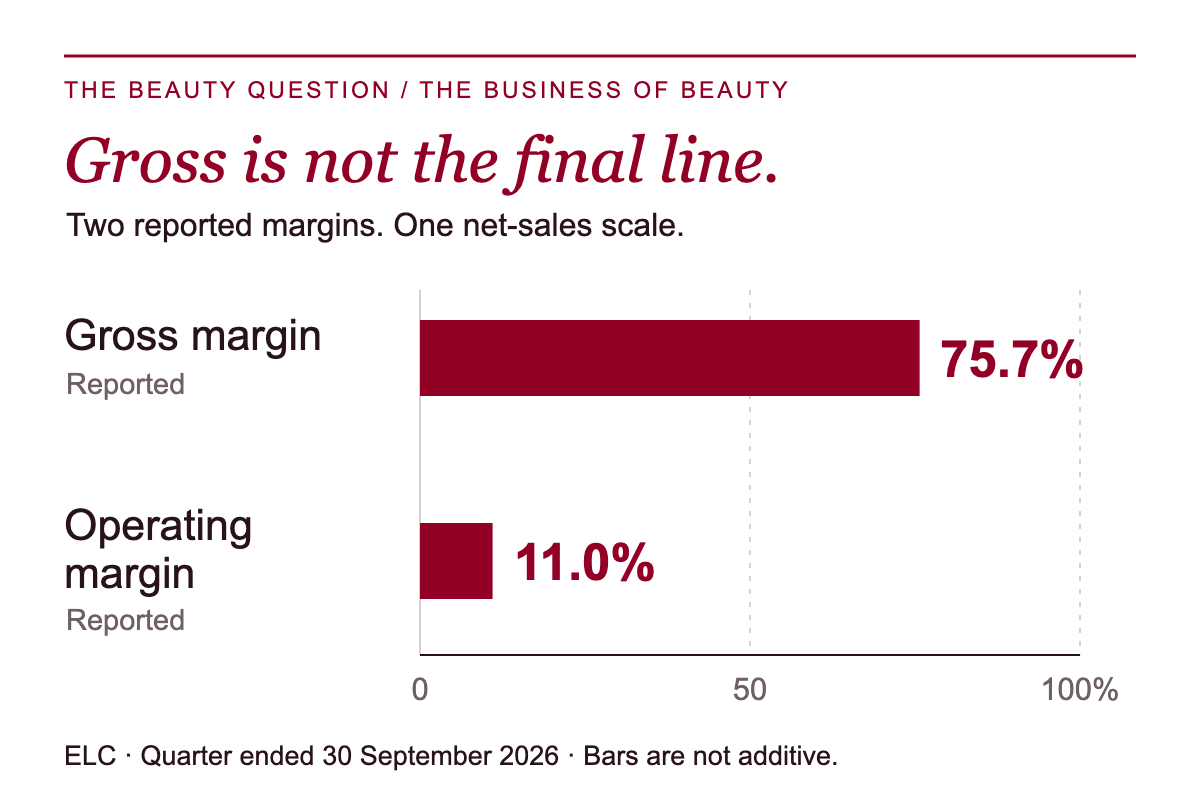
In these results, reported gross margin was 75.7%, and reported operating margin was 11.0%. A separate, adjusted operating margin was 12.1%; the reconciliation excludes restructuring and other charges. Adjusted is a defined non-GAAP measure, with its own reconciliation.
Operating profit still comes before interest and income tax. The two reported margins therefore describe different stages of the same income statement. They should not be added together, and neither is a product’s markup.
Nor can the group’s gross margin price the contents of a particular jar. The accounts cover a portfolio and a period, using the company’s sales. They do not disclose what it cost to manufacture the cream you are holding. Reading a percentage backwards from a British shelf price would produce an impressively precise answer to a question the figures have not answered.
The release also reports Amazon coverage of 13 brands across 17 markets and TikTok Shop coverage of 15 brands across 11 markets. These are group footprints, not a statement about UK availability. For a beauty reader, distribution is the more tangible part of the story: the familiar counter brand can meet you through another kind of shop window.
A screen offers convenience and comparison; a counter can offer a conversation and a chance to see a colour in person. Neither setting settles the quality of everything sold there. Wherever you meet a familiar name, it is worth checking the particular seller, the actual price and the product details. Recognition of a brand should begin the enquiry, rather than finish it.
The same discipline helps with performance claims. Ask what the product says it does, what evidence supports that result and whether the test concerns the finished formula you would buy. There may be persuasive evidence for an individual product. A group earnings release is serving a different purpose. Successful selling is worth understanding without being recruited as a substitute for product testing.
None of this requires disliking a successful beauty company. It means keeping two questions alive at once. Is the business selling well? And is this something I want, at this price, for the job I need it to do? The accounts can illuminate the first. Your shopping decision still has work to do.